
We manage environmental risks and opportunities within our existing risk management process and promote continuous improvement initiatives that enable long-term resilience. Our balanced business model and diverse lines of business across multiple states and countries are designed to enable each business to develop its own set of operating objectives to address environmental risks and opportunities that are relevant to their individual circumstances.

Environmental Management
Each of our businesses has professional environment, health and safety (EHS) programs to ensure that our facilities operate safely and comply with company programs and practices. Our approach to protecting the environment is built around these objectives:
- Operate our facilities in compliance with applicable laws and regulations to protect employees, communities and the environment.
- Improve operational efficiency and responsibly manage energy use and emissions consistent with business and customer requirements.
- Reuse, recycle and minimize the use of natural resources.
- Reduce solid waste from our manufacturing processes.
- Incorporate EHS considerations into business planning and operations, including design, procurement, production, facilities management and product support.
- Adapt our processes and approach as appropriate as the business evolves.
- Work with customers to meet their environmental needs and goals.
- Manage suppliers in a way that is consistent with our environmental compliance and management programs.
- Maintain an EHS management system at each business unit, designed to support compliance and voluntarily meet internationally accepted standards.
Our EHS and Sustainability Committees within the Manufacturing Council include experts from each business to promote best practices and develop shared strategies. Their goal is to promote a culture of safety and sustainability across the company and to monitor changes to and compliance with laws, regulations and corporate policies.
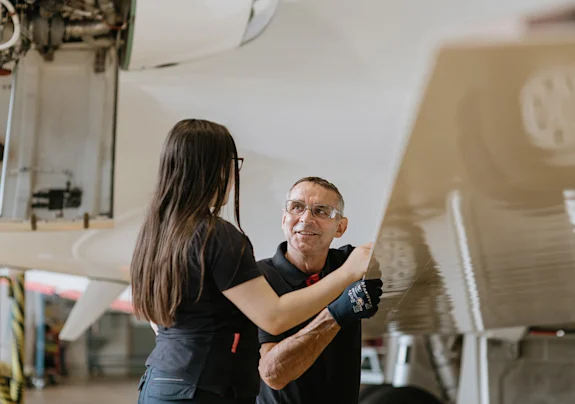
Resilient Business Operations
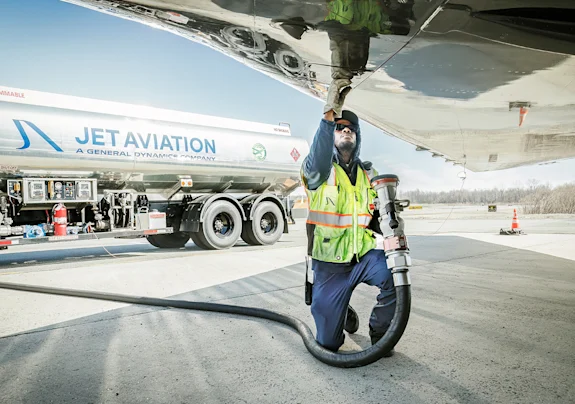
Emissions and Energy Management
We have a companywide target of reducing Scope 1 and Scope 2 emissions by 40% by 2034, from a 2019 base year. Aligned with our decentralized business model, each business unit applies its knowledge of its market, customers and operations to pursue its own reduction path that supports the companywide target.
Carbon intensity, emissions per dollar of revenue, helps provide a normalized measure to assess the company in relation to emissions. These numbers demonstrate that our business operations continue to become more efficient over time, even as our business is growing.
See our Sustainability Report for additional details about are emissions reduction efforts and progress against our target.
Sustainable Aviation
We continue to focus research and development efforts on achieving better efficiency and fuel performance, continuing to use increasing volumes of sustainable aviation fuel (SAF) in our operations, and making book-and-claim services available to our customers.
Both Gulfstream and Jet Aviation have made SAF an integral part of their emissions reduction strategy.
Both Gulfstream and Jet Aviation have made SAF an integral part of their emissions reduction strategy.




CDP
2024 CDP Climate Change Response
Archive: 2023, 2022, 2021
Archive: 2023, 2022, 2021